

We spent Christmas morning in church in Mossel Bay, opened presents, loaded two cars, and drove to Hell.
It was not a plan so much as a dare. The grandparents led. My seven-year-old and I followed. By the time we came back over the mountain in the dark we had driven the route that Forgotten Routes now runs as The Ladder, and we knew we would be back with more cars.
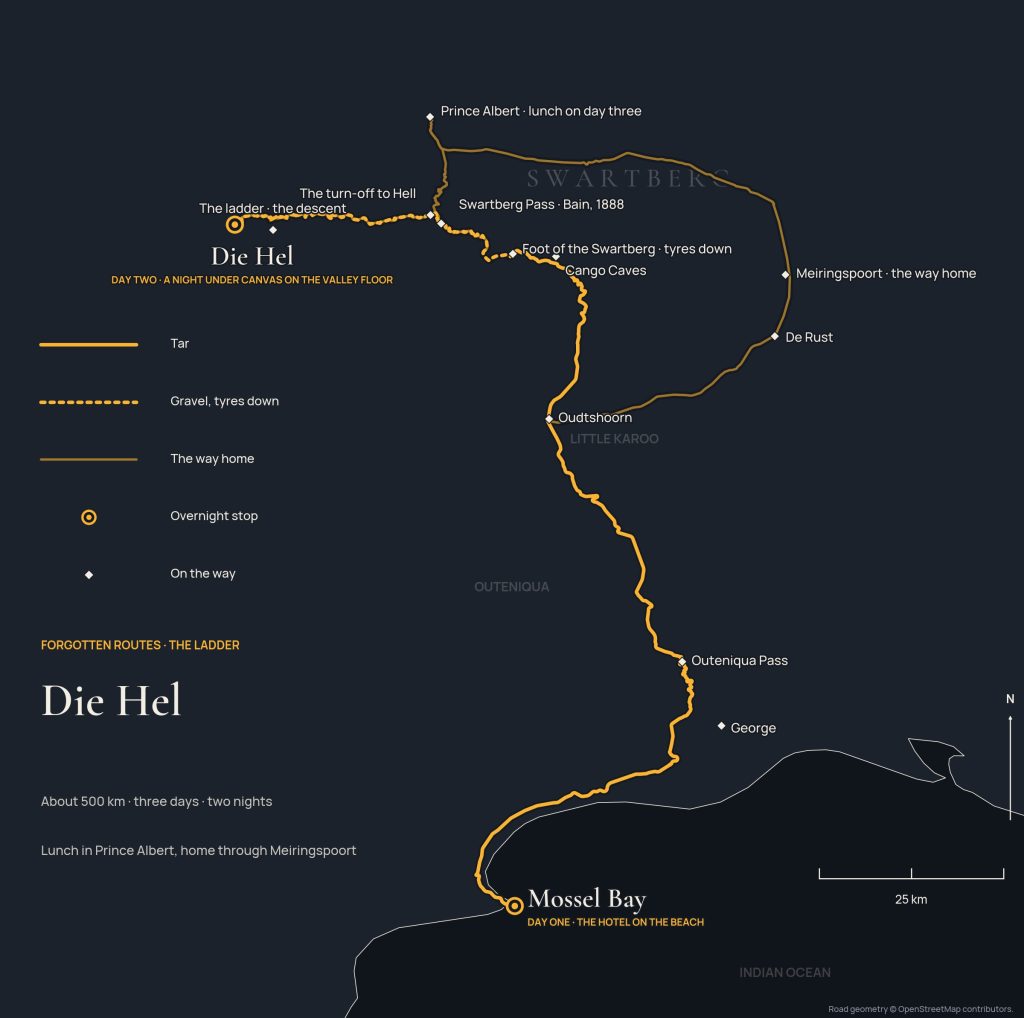
Mossel Bay to Oudtshoorn
The road inland is lovely and it lulls you: rolling hills, gold fields, the Outeniqua standing across the horizon. It was 34 degrees outside. It was 20 inside the car, which is the kind of detail that matters more than it sounds by the end of a day like this.
On the expedition this is the first hour and a half, out of the hotel car park with the sun coming up over the bay, while the mountains get bigger in the windscreen.
The pass
Out of Oudtshoorn the road starts climbing, and the Swartberg starts showing off. These mountains are part of the Cape Fold Belt, somewhere over 300 million years old, ancient seabeds folded and stood on end. The pass through them was built between 1881 and 1888 by Thomas Bain with convict labour and hand tools, and his dry-stone retaining walls are still holding the mountain up more than a century later. Every hairpin gives you another view of the Little Karoo, and every cutting shows you rock bent into shapes that do not look possible.
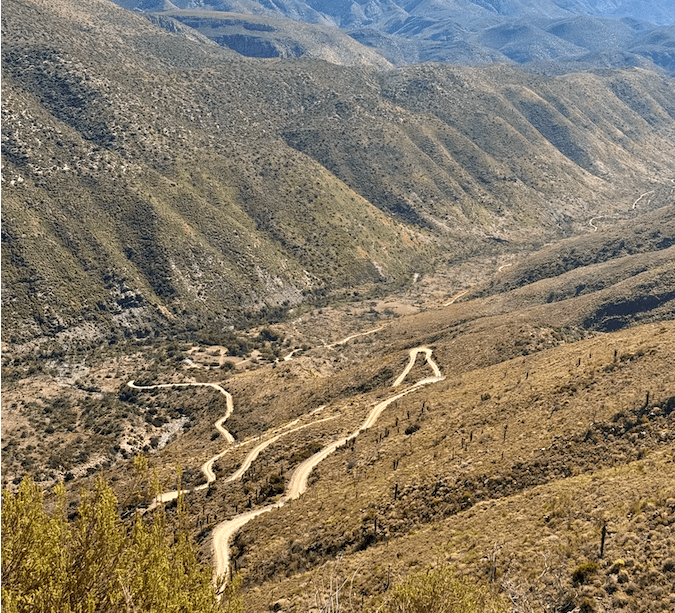
Where the tar ends we let the tyres down. That is the moment the day changes. On The Ladder it is also where we walk around every car with its owner and show them the four controls they have never pressed.
Down into Die Hel
Near the top of the pass a small sign points off to Gamkaskloof, the valley everyone calls Die Hel. From the turn-off to the valley floor is about 48 kilometres of gravel, ending in a run of switchbacks down a mountainside so steep the road looks drawn on with a pencil. There are a few places where the drop beside you is the kind you do not look at for long.
Two standard luxury 4×4s on road tyres took it slowly, low range and first gear, pulling into the viewpoints to let cars coming up get past. Every stop was another look at the valley below, a strip of green in a very dry mountain. It feels like driving backwards in time, which in a sense it is.
People settled Gamkaskloof in the 1830s, farming families who wanted to be left alone and got their wish for over a century. They farmed, they bartered with the towns over the mountain, and they came and went on foot up a path so steep it was called the ladder, because the road was not built until the 1960s. That path is where the expedition got its name.
Ouma Sannie’s
Lunch was on the valley floor, plates of proper food and a room full of the valley’s history on the walls. Somewhere between the second helping and the coffee I said, “It is not as bad as the dominee tells you it is,” and everyone at the table agreed that Hell was worth the drive.
That day we turned around after lunch. On The Ladder you do not. The camp is already standing on the valley floor when you arrive: a private suite for each car, champagne on ice, a chef at the fire, and the quietest sleep in the country. The climb out waits until the morning.
Out
The switchbacks feel steeper going up. The cars did not mind. We kept pulling over for oncoming traffic and kept marvelling at how fast the descent had gone in the morning. By then the light was going gold and amber across the peaks, and the seven-year-old had his face against the window, staring down the drops.
We crested the Swartberg as the sun went, long shadows across the whole valley, one last look, and then the long run back to Oudtshoorn and Mossel Bay in the dark.

Why it matters
The Swartberg is a hundred and forty years of engineering, and at the bottom of it a valley that stayed hidden until living memory. For our family it was a Christmas we will still be talking about when the seven-year-old has children of his own.
We did it in a day because we had to. It deserves three. That drive is now The Ladder: a hotel on the beach at Mossel Bay to begin, the convoy over the Outeniqua at sunrise, tyres down at the foot of the Swartberg, the pass, the descent into Die Hel behind the lead car, and a night under canvas on the valley floor. The last morning you climb out and keep going, over the top and down the north side of the Swartberg to Prince Albert, a Karoo village of old Cape Dutch houses and water furrows under the mountain, for a long lunch. Then home through Meiringspoort, where the road crosses the same river twenty-five times inside a gorge, so that you see the Swartberg from every side it has. Four cars, two guests each, on request.
To Hell and back. We would do it again tomorrow, and now we do.
